
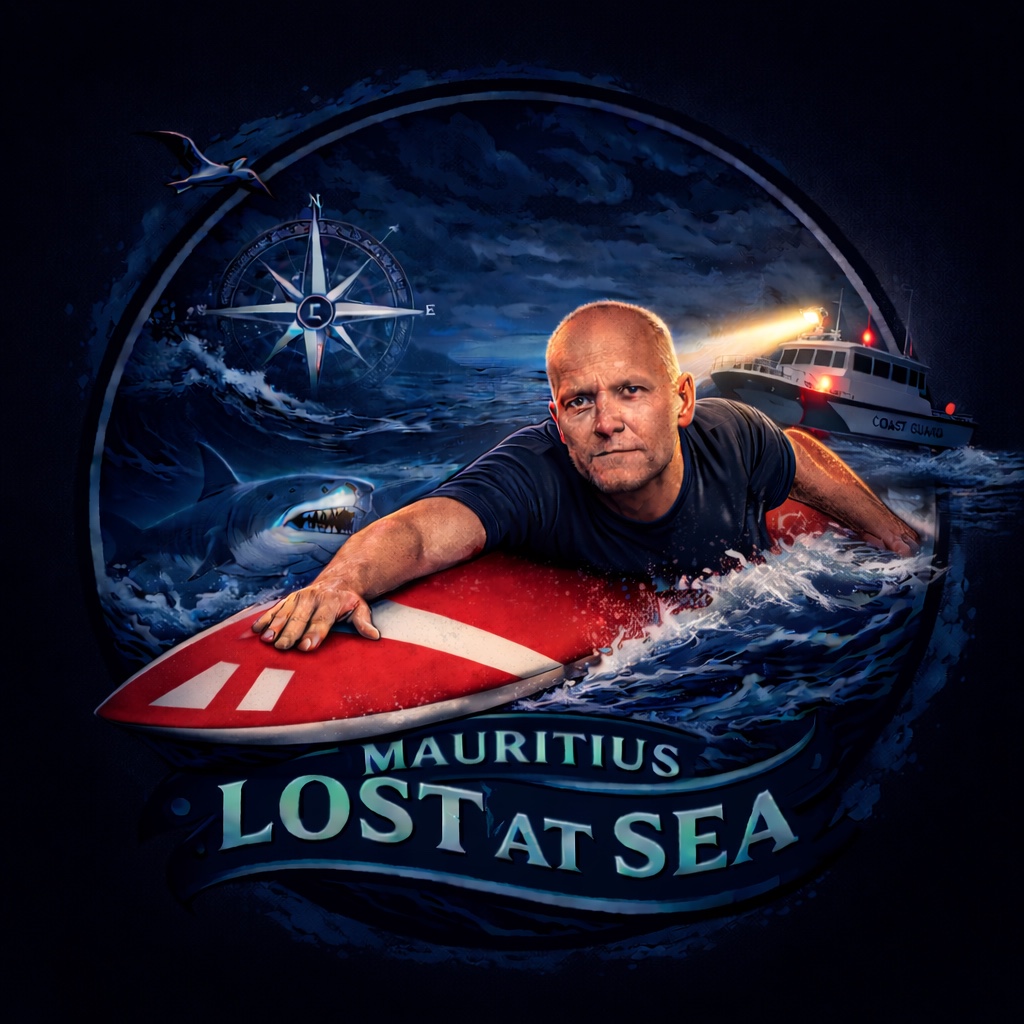
On 27 May 2020, what began as a normal windsurfing session in Le Morne, Mauritius, turned into a fight for survival. For more information go to. https://www.windsurf.co.uk/lost-sea-windsurfers-story/
The afternoon looked manageable. The wind was steady, the sky was clear, and the lagoon seemed familiar. But Le Morne is a place where beauty and danger live side by side. Beyond the calm lagoon lies open ocean, and between them run powerful channels and reef passes shaped by tide, swell, and current. Some of these currents are nearly invisible, yet strong enough to pull a rider out to sea within seconds.
Cédric Dejean knew the area, but that day one missed jibe changed everything. While planing downwind, he drifted too close to the lagoon exit and was caught by a violent riptide. In moments, he was dragged away from shore, away from his friend Susan, and toward the open ocean. The shoreline shrank. Control disappeared. The session was over. Survival had begun.
Cédric was not a casual athlete. At fifty-one, he had built his life around endurance and challenge. He was also living with Parkinson’s disease and had turned to windsurfing as both therapy and resistance. Sport helped him stay strong, mobile, and mentally sharp. That stubborn determination would become his greatest asset once the ocean took over.
At first, he believed he could still recover. He tried to water-start. He tried to use the sail. But the wind weakened at the worst possible moment, and the current kept carrying him farther out. Soon he was near the dangerous water around Chameaux and One Eye, where heavy waves and reef made every decision more critical.
As the situation worsened, his equipment also began to fail. Part of the rigging became unusable, and the sail was no longer helping him escape. Instead, it became extra drag. With daylight fading, he made the decision that likely saved his life: he abandoned the rig and kept only the board.
From that point on, there was no more windsurfing. There was only paddling, judgment, and willpower.
Alone in the Dark Ocean
Nightfall, search lights, and open water
| “Out there, survival stopped being about sport. It became a test of mind.” |
Once night began to fall, the scale of the danger became fully real.
Cédric paddled with only his board, trying first to return directly, then searching for any possible route back to safety. He was exhausted, dehydrated, and already injured from the rough surface of the board and the force of the water. Then rescue boats appeared. He could see their lights sweeping across the sea. He knew they were searching for him. He tried desperately to make himself visible, but the open ocean swallowed him. The boats never saw him.
Darkness closed in completely. The moonless sky turned the sea black. Horizon, water, and sky merged into one void. Sight became nearly useless. He began navigating by sound, listening to waves to judge where danger might be. Every movement required energy. Every stroke hurt. Outside the reef, another fear pressed into his mind: sharks. He was cut, bleeding, and alone in water known for them. Still, stopping was not an option.
What helped him most was one small piece of equipment on his wrist.
Before heading out, he had entered the coordinates of home into his Suunto watch. In the middle of the crisis, it became his guide. It showed distance, direction, and a path forward when the island itself could no longer be seen. More than that, it gave him a reason to keep paddling. Even in total darkness, the watch proved that shore still existed somewhere ahead.
At one point, he understood that forcing his way directly back through the strongest current was hopeless. So he made a bold choice: paddle farther out into the open ocean, where the water might calm, then return from a better angle. It was risky, but it worked. The sea grew quieter, and for the first time in hours he could think strategically instead of only reacting.
His body was failing. His skin was raw. His motivation dipped dangerously low. But he kept repeating to himself that he could continue. A few more strokes. Then a few more. Then more again.
The battle was no longer about strength alone. It was about refusing to stop.
Back Alive
Return through the reef
After hours in the open ocean, a small sign appeared: lights.
At first they were faint and uncertain, but they were enough. Hotels along the coast were coming back into view. Hope became visible again. Cédric kept paddling toward them until he reached the reef near L’Ambulante. Even there, the danger was not over. Entering the reef at night meant risking violent impact with wave and coral. One wave lifted him and threw him forward, but he managed to keep hold of the board. He knew that losing it at that final moment could still cost him everything.
Then the water became shallow.
He had reentered the lagoon.
The final meters were painfully slow. He still had to swim and drag himself toward the beach through exhaustion, salt-burned eyes, and pure fatigue. But at around 00:15 on 28 May 2020, after more than eight hours in the water, he stood on the beach alive.
People on shore recognized him immediately as the windsurfer who had been lost at sea. Soon after, he was reunited with his friends. Police and coast guard teams arrived as well, astonished that he had returned on his own after so long in the ocean. Relief replaced fear. The impossible had happened. He had come back.
The story leaves a clear lesson. The ocean can change everything in seconds. Preparation matters. Judgment matters. Equipment matters. Cédric later emphasized simple rules: never go alone, never go too late, check conditions carefully, carry safety gear, and above all, never leave your board.
But beyond safety, his experience says something bigger. This is a story about endurance. About adapting under pressure. About staying mentally alive when fear and exhaustion say otherwise.
Not because he was lost. Because he came back.